Key takeaways
A roof inspection includes a close look at your shingles or tiles, the flashing around chimneys, walls and vents, your gutters and roof edges, and your attic. A good inspector finishes with photos and a written report so you know exactly what your roof needs.
After a long Houston storm season, it's normal to wonder if your roof came through okay. Here's what a professional roof inspection covers, what you get at the end, and how often you should have one done.
A complete inspection covers four areas: the roof surface, the flashing and penetrations, the edges and drainage, and the attic. Here's what the inspector checks in each one.
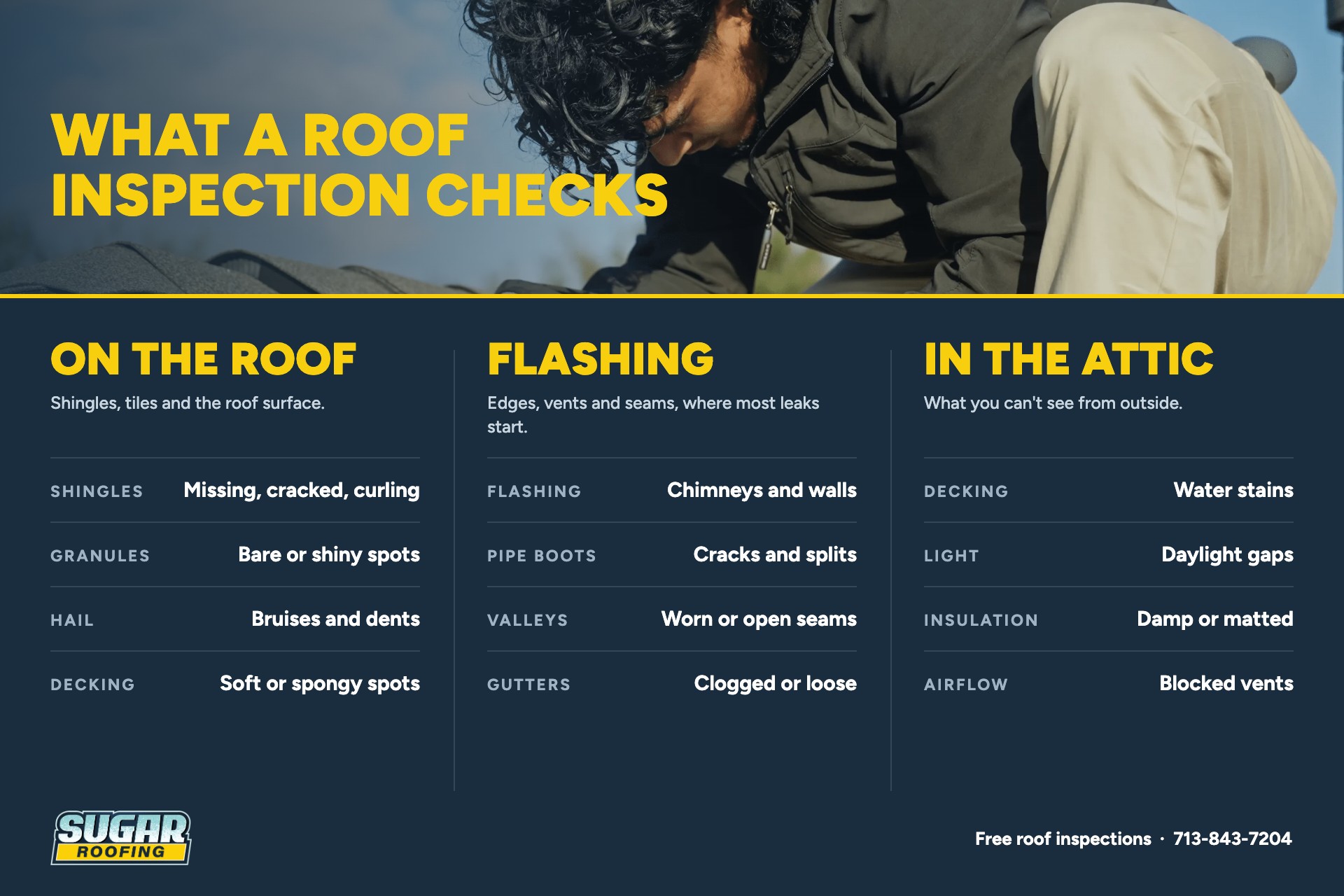
The inspector walks the roof, or uses a drone on steep roofs, and checks for:
On tile roofs, the focus shifts to cracked, slipped or broken tiles. Our guide on how to identify damage on tile roofs covers what to look for.
This is where most leaks begin. Anywhere something passes through the roof or meets a wall, there's a seam that has to stay sealed.
New to these terms? Our list of common roofing terms explains flashing, pipe boots and more.
Water collects and moves fastest in the valleys and along the edges, so small problems there turn into leaks quickly.
The attic shows problems you can't see from the roof. With Houston's heat and humidity, this part of the inspection matters a lot.
Poor airflow traps heat and moisture, which ages shingles and can lead to rot. See our attic and roof ventilation service for how a balanced system works.
You should walk away with proof, not just an opinion. A useful inspection ends with:
At Sugar Roofing, every free roof inspection includes a POV video walkthrough of your roof and a digital report with annotated photos. Our team also uses thermal imaging to help spot hidden leaks.
Most inspections of a single-family home take about an hour. Steep roofs, tile roofs, large homes, and attics that are hard to reach can take longer.
Plan to be home for the end of the visit so the inspector can walk you through the photos and answer questions.
Once a year is a good rule, plus an extra inspection after any major storm. Schedule one sooner if you notice a ceiling stain, shingles in the yard, or granules piling up in your gutters.
Fall is a smart time in Houston. The Atlantic hurricane season runs from June 1 to November 30, so an inspection at the end of the season catches damage before winter rains and gives you time to plan repairs before the next one.
It's also worth getting an inspection when you're buying or selling a home, or when your roof is getting close to the end of its expected life. Our guide on how long a roof lasts can help you estimate where yours stands.
Three different people might inspect your roof, and each one is looking for something different.
If you think a storm damaged your roof, have a roofer inspect it first. Their photos and report help you decide whether filing a claim makes sense.
There's no single pass or fail score, but these findings usually lead to a repair or replacement recommendation:
Not sure which way to go? Read when to repair or replace your roof.
You can do a quick check from the ground, but leave the climbing to a pro. Walking a roof is dangerous, and it's easy to miss damage or cause more.
After hail or high winds, the Texas Department of Insurance recommends that you file a claim as soon as you can, get more than one repair estimate, and be available for the adjuster visit. It also warns against contractors who offer to waive your deductible.
A detailed inspection report with photos makes that process easier. Our team can meet your adjuster on site through our insurance claim assistance service.
Call for an inspection right away if you see water stains on a ceiling, shingles or tiles on the ground, daylight in the attic, or dents on gutters and vents after a storm. Small problems are much cheaper to fix early.
Sugar Roofing offers free roof inspections across Greater Houston, with a POV video and a photo report so you can see everything we see.
Many roofing companies, including Sugar Roofing, offer free inspections. A paid inspection usually comes from a home inspector during a sale or from a specialist report. Ask up front what the visit includes and whether you get photos and a written report.
A thorough one does. The attic is where you can see the underside of the decking, leak stains, damp insulation and ventilation problems that never show up from the roof surface.
It can give you a good estimate. The inspector looks at shingle wear, granule loss, flashing condition and past repairs, and compares that with the roof's age and material.
You should get photos of every problem and clear options, usually a repair, a replacement, or an insurance claim if storm damage is involved. A good inspector explains the choices without pressure.
A real roof inspection covers the surface, the flashing, the edges and the attic, and ends with photos and a written report. Get one every year and after major storms, and you'll know exactly what your roof needs before the next storm hits. Schedule your free roof inspection or call 713-843-7204.
